
The Human Operating System
Why 2026 Will Be About Rebuilding How We Live, Work, and Recover


By the end of last year, something became impossible to ignore.
In early December, while attending several conferences and private gatherings in Berlin, I found myself in repeated conversations with HR and Learning & Development leaders across industries. Different countries. Different company sizes. Different levels of budget and maturity. Yet the same pattern surfaced again and again.
They all recognized the value of wellbeing.
Most had tried something themselves. Meditation apps. Breathwork workshops. Occasional retreats. One is training to become a tai chi instructor. A few had even rolled out wellbeing initiatives internally. The belief was there. The intention was there. In many cases, the business case was there too.
What was missing were the conditions.
Despite genuine awareness, the environments they and their people operate in make long-term wellbeing nearly impossible to sustain. Work rhythms reward constant availability. Recovery is treated as optional. Stress is normalized. Focus is fragmented. Even highly motivated employees struggle to apply what they know helps them.
That disconnect stayed with me. Not because it was surprising, but because it clarified something essential.
We are not facing a motivation problem.
We are facing a systems problem.
Why This Moment Matters
We are entering 2026 carrying unresolved consequences from the last few years. The pandemic did not simply disrupt routines. It exposed how fragile our personal and organizational systems had become.
Burnout rates remain elevated. Chronic stress is widespread. Metabolic and mental health challenges continue to rise. At the same time, productivity expectations have not softened. In many cases, they have intensified.
Reports from the World Health Organization and the OECD show a sustained decline in mental wellbeing across working populations. Consultancy data from McKinsey and Deloitte points to burnout as a structural business risk rather than an individual failure.
Part of the reason this problem persists is that we are living through an era obsessed with operating systems, just not the human one.
We spend enormous energy discussing AI systems, digital platforms, and technological infrastructure, while quietly forgetting the one system everything ultimately runs on. Every decision, every strategy, every organization still operates on top of a human nervous system, a human metabolism, and a human capacity for attention and recovery.
No matter how advanced our tools become, performance, judgment, and resilience remain constrained by the same biological operating system we have always had. Ignoring that reality does not make it irrelevant. It makes failure more predictable.
From Longevity to Healthspan, for Everyone
Last year, I wrote about longevity for all, arguing that extending life without improving its quality is not progress. Healthspan, the years we live with energy, clarity, mobility, and agency, is the metric that actually matters.
What the data continues to show is that healthspan is unevenly distributed. Where you live, how you work, what food is available, how much autonomy you have over your time, and whether recovery is structurally supported, all shape outcomes far more than individual discipline ever could.
This is not a failure of personal responsibility.
It is the result of misaligned systems.
Healthspan is quietly becoming the next major inequality. And unlike access to healthcare alone, it is deeply tied to how daily life is designed.
Wellness Travel Is a Signal, Not a Solution
One response to this misalignment has been the rapid rise of wellness travel, particularly among high-net-worth individuals. Retreats, longevity clinics, curated reset experiences, and executive offsites are growing at record pace.
On the surface, this looks like a luxury trend. Underneath, it is something else.
People are leaving their environments to feel functional again.
Wellness travel works because it temporarily restores conditions the nervous system and metabolism recognize as supportive: slower rhythms, better food, natural light, movement, recovery, and fewer competing demands.
But the moment people return home, the old inputs resume.
The problem is not that these experiences fail.
The problem is that they are isolated from the systems people return to.
Temporary relief without structural integration does not create lasting change.
The Human Operating System
In many of my workshops, I often say the same thing: our body is an extraordinary machine, capable of adaptation, healing, and performance that still outpaces most technologies we’ve built. But somewhere along our path toward modernity, we lost the manual.
We kept upgrading the environment, faster systems, smarter tools, denser schedules, without updating our understanding of how the human system actually works inside them.
The idea of a Human Operating System emerged from that gap. Not as a metaphor, but as a reminder.
Over years of working in high-pressure business environments, traveling extensively, and having hundreds of conversations with founders, executives, HR leaders, health practitioners, and everyday people, the same patterns repeated themselves.
When inputs do not match human biology, breakdown becomes predictable rather than personal.
At its simplest, the Human Operating System can be visualized like this:
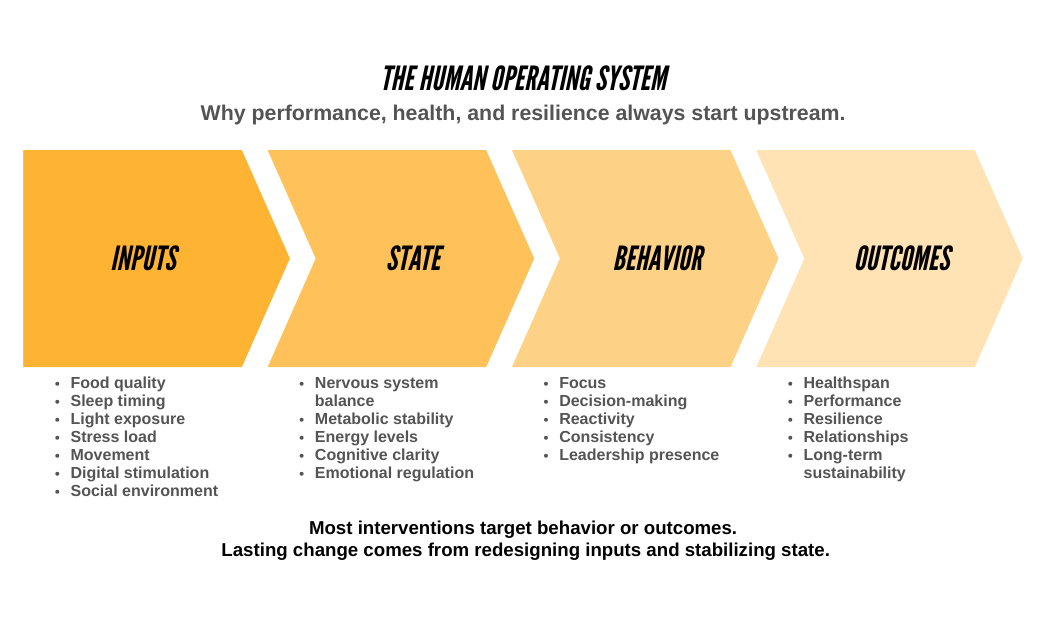
Most interventions focus on behavior or outcomes.
Very few address inputs and state in a systematic way.
That is why so much effort produces so little lasting change.
The Human OS Manual
The Human OS Manual is my attempt to recover that missing manual and place it back at the center of how we design life, work, and the technologies that increasingly surround us.
It is a synthesis of years spent inside complex organizations, building teams and ventures of my own, extensive travel across different cities and rural areas, and careful observation of how different environments reliably produce different outcomes.
The Manual is not about optimization or biohacking.
It is about coherence.
When the system makes sense, people do not need heroic discipline. They need supportive defaults.
The Reverse Aging Challenge as Applied Practice
Frameworks matter only if they change how people live.
The Reverse Aging Challenge exists as a practical application of the Human OS Manual. It is not a promise of immortality or a shortcut to perfection. It is a structured, time-bound way to experience what happens when core inputs are aligned with human biology.
Breathwork, movement, fasting, thermal exposure, and mindset work are not trends. They are levers. When applied deliberately, they stabilize state and make better behavior easier rather than harder.
For many participants, the most noticeable shift is not physical. It is the return of clarity, emotional regulation, and focus once the system is no longer under constant strain.
What 2026 Is Really About
As I look ahead, 2026 is not about launching more programs. It is about building infrastructure.
Infrastructure for individuals to recover without disengaging from life.
Infrastructure for organizations to support performance without burning people out.
Infrastructure for healthspan that does not depend on privilege or escape.
The conversations I had with HR and L&D leaders in December made one thing clear. Awareness is no longer the bottleneck. Environment is.
If we want healthier people, better decisions, and sustainable performance, we must redesign the systems people operate inside.
The Human Operating System is a way to do that.
Reflection
What would change if we stopped asking people to cope better and started building environments they could actually function within?